Axiomeer
A universal marketplace and API gateway for AI agents: natural-language discovery across 91+ services with semantic search, provider fallbacks, and workflow chaining.
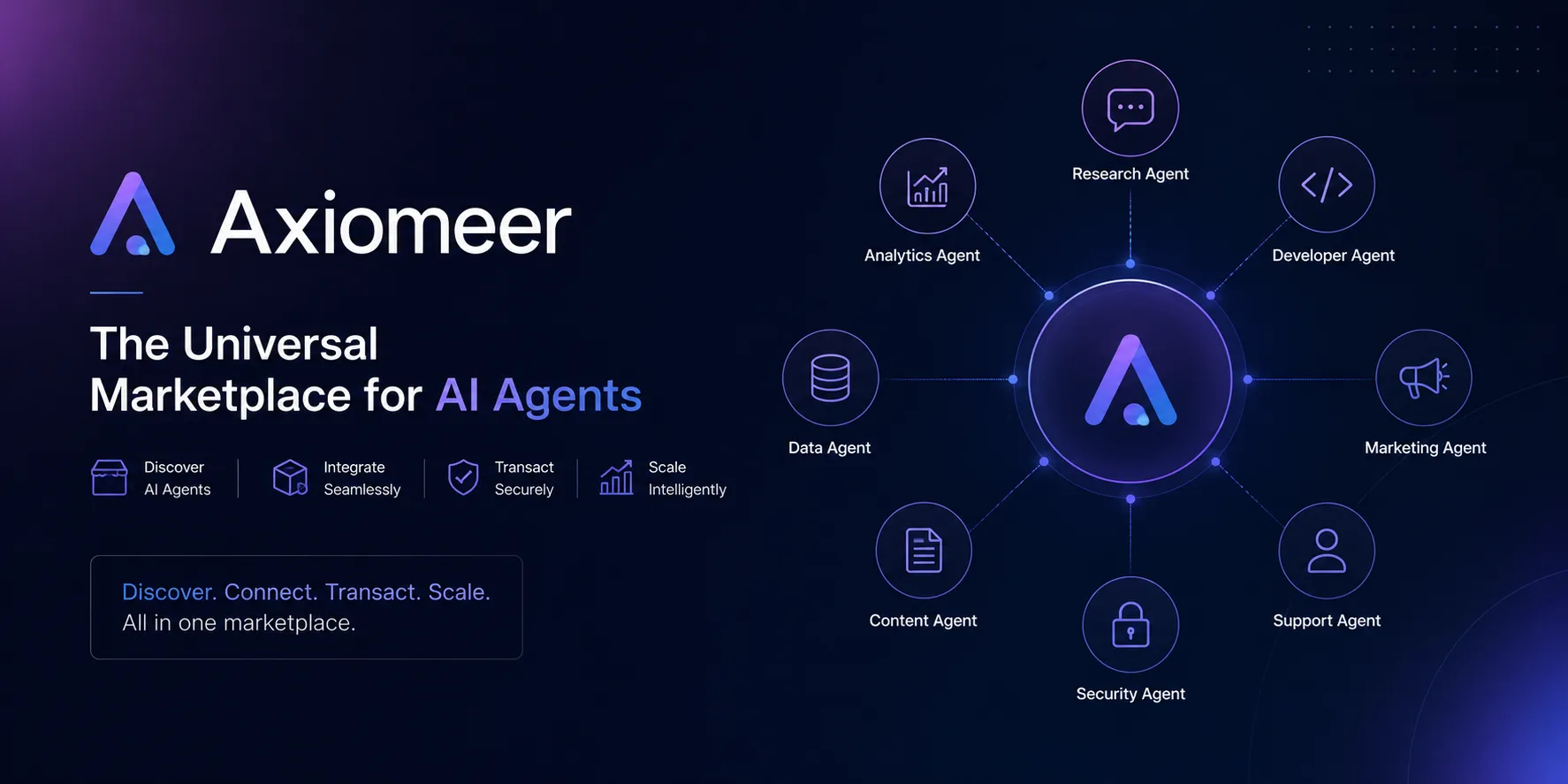
An agent that needs weather data shouldn’t hard-wire an API.
Agents constantly need external capabilities, weather, finance, search, translation, but wiring each provider by hand is brittle and does not scale. The goal: ask in plain English, get the right API, execute in three lines of code.
`client.shop("get weather in Tokyo")` returns a recommendation; `/execute` runs the chosen provider.
Deterministic ranker narrows, LLM agent decides.
Routing happens in two stages. A FAISS semantic search over 384-dim embeddings plus a weighted ranker, capability (70%), relevance (25%), trust (15%), minus latency and cost penalties, narrows 91+ APIs to ~8 candidates. A local LLM sales agent then makes the final pick with a rationale.
A manifest schema (`http_method` + `input_schema`) lets the LLM extract parameters, and a Redis-backed trust-score cache (60s TTL) avoids a full-table scan per request.
Built for real production traffic, not a toy demo.
Provider fallback auto-retries the next-ranked provider on failure; retry-with-backoff handles transient errors; a quarantine filter drops bad providers; and a background task refreshes provider latency every five minutes. Real `cost_est_usd` is logged per execution.
Multi-step workflow chaining passes data between steps, SSE streaming emits real-time progress, and conversation memory is isolated per authenticated user.
Shipped with SDKs and enterprise auth.
Axiomeer ships a Python SDK (`pip install axiomeer`) and a TypeScript SDK, with JWT + API-key auth, bcrypt hashing, rate limiting, and Alembic-managed Postgres migrations behind it.