Verix
Open-source cryptographic trust infrastructure for AI agents across organizations: post-quantum identity, bilateral authorization, and a tamper-proof audit ledger, without sharing private data.
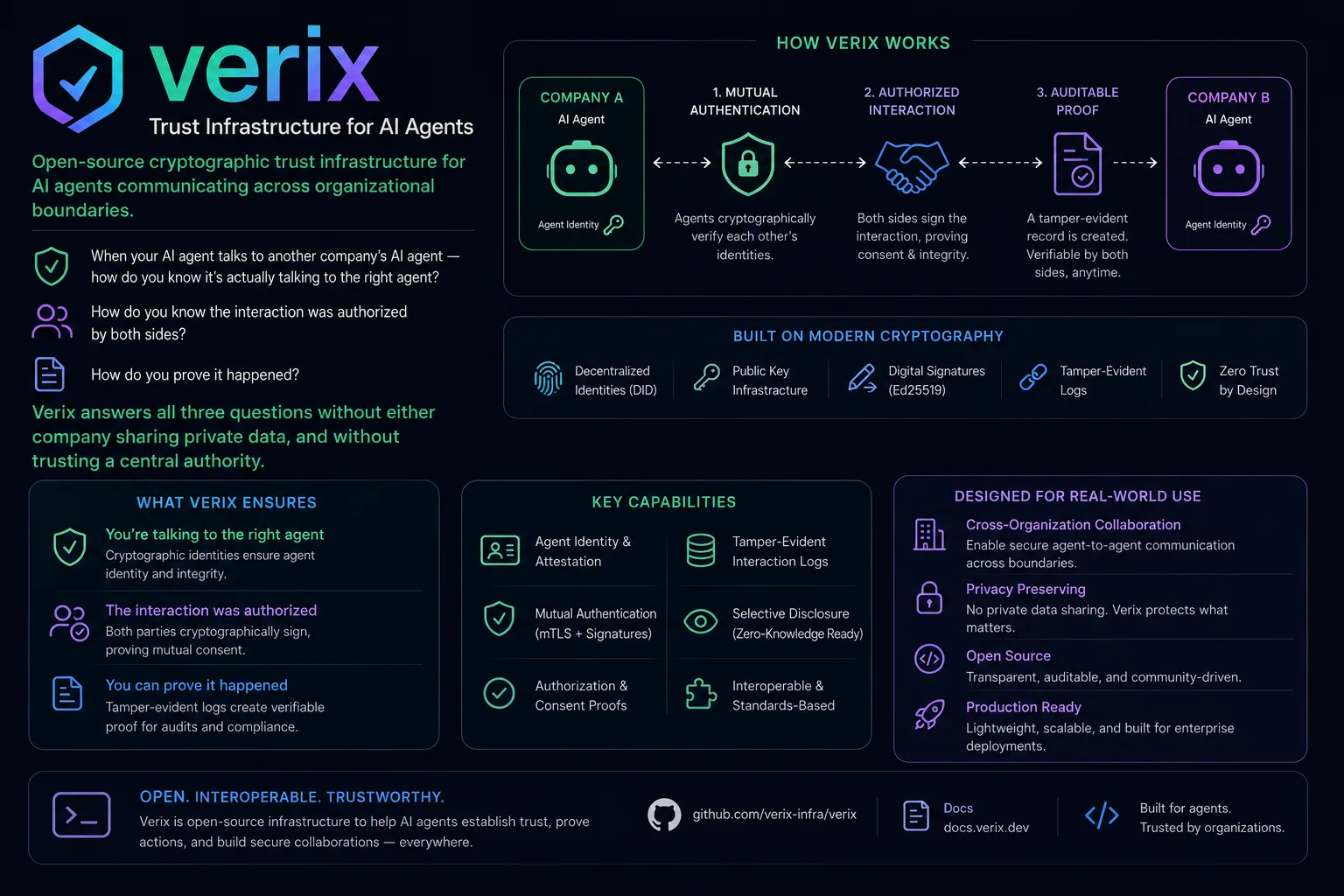
When your AI agent talks to another company’s agent, how do you trust it?
Cross-organization agent interactions, a procurement agent sending a purchase order, a healthcare AI querying a partner lab, all raise the same unsolved questions: identity (is it really their agent?), authorization (did both sides agree?), and audit (can either party prove what happened, years later?).
OAuth, mTLS, and API keys were built for human-facing APIs, not autonomous AI-to-AI communication where both parties need independent cryptographic proof.
Cryptographic proof without a central authority.
Verix issues per-agent identity certificates signed with hybrid Ed25519 + ML-DSA-65 (NIST FIPS 204 post-quantum) credentials. Every interaction requires bilateral authorization, both organizations’ policies must independently approve it.
A tamper-proof ledger (sequential chain hash + Merkle tree per org pair) produces O(log n) inclusion proofs, so any transaction can be proven without revealing the full history. Companies run their own federated nodes with peer-to-peer discovery, no central registry.
Store proofs, never content.
Verix records only hashes of parameters and outcomes, never message content, so the trust layer itself never becomes a data-leak surface. Replay is prevented by recording each token’s JWT ID on first use.